
KY Zoo
Kūki o yomu is one of the most important abilities one can possess in Japanese society.
Without it, you are flying blind—standing in see-through underwear with little hope of finding a meaningful place within Japanese society, for it is the air itself that one must first learn to read.
Even more importantly, becoming aware of this essential protocol is the first step toward acquiring the magic of reading the air—which is precisely what kūki o yomu means.
Never underestimate this critical social skill, for it is a secret weapon that keeps your ship upon an even keel.

As time marches on and the air surrounding us becomes increasingly polluted with tonnes of bad vibration, it is important to remember that the world we inhabit is, in reality, a quantum zoo.
Your superposition within this mythological zoo depends entirely upon the degree to which you can read the air—kūki o yomimasu ka?
For reading the air in Japan is something altogether different from merely reading the room, as you shall soon discover.
The degree to which one has mastered kūki o yomu largely determines the position one is able to secure within this earthly zoo —the ancient nation of Japan.

Along with choosing your master wisely, it is equally important to understand your position within the earthly zoo—particularly within the hierarchical structure of the phantasmagorical world of the Japanese.
The ability to see what cannot be seen, to smell the essence lingering within the scene, and to read the phacken room is among the most valuable social skills one can ever acquire.
Here is the full skinny behind the linguistic concept of kūki o yomu—understanding the importance of what remains unsaid while simultaneously ascertaining the social position of everyone who is there.
In Western culture, the default assumption is that meaning resides within the spoken word.
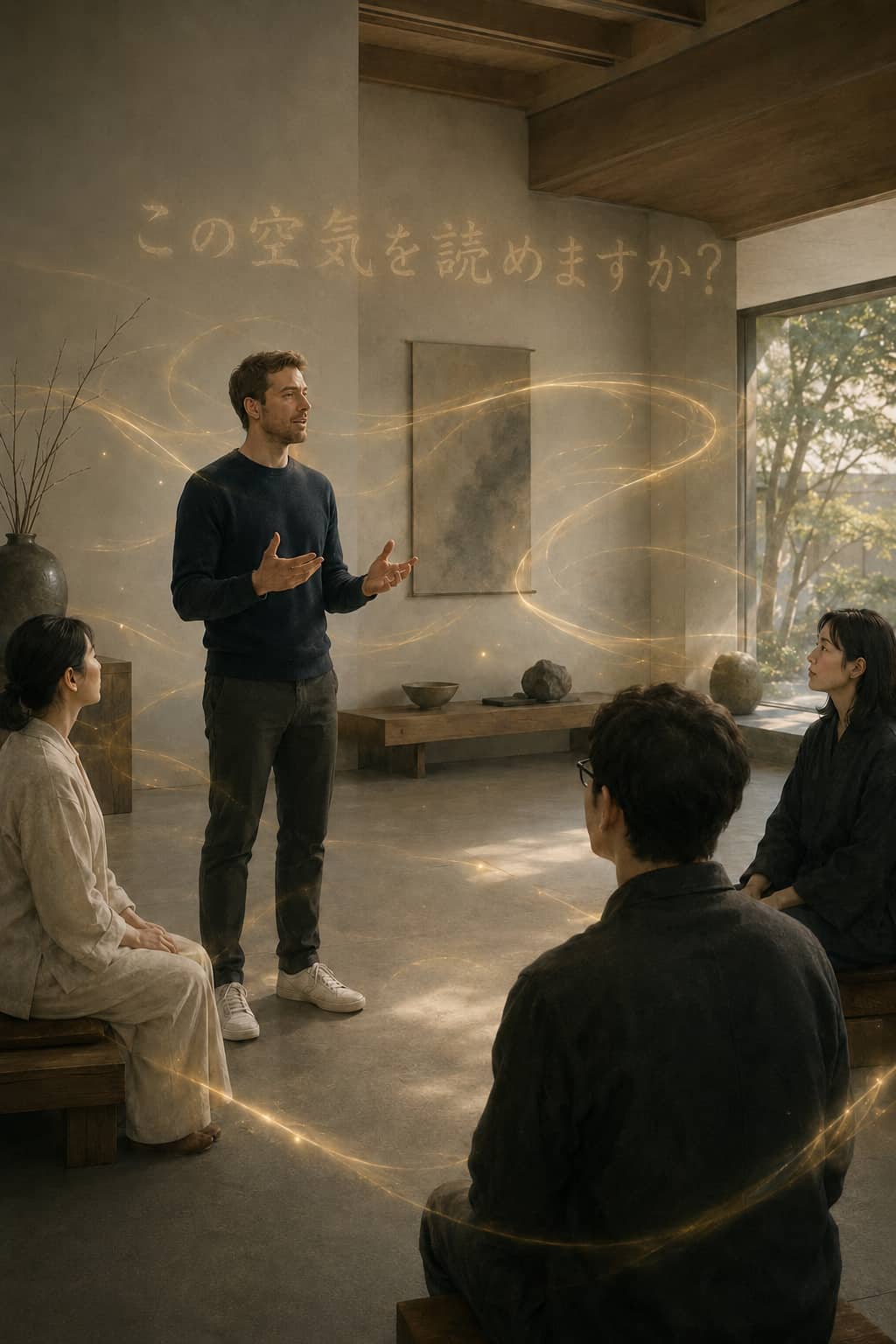
In Japanese culture, trust is established within the surrounding vibration field, where spoken words carry far less weight than the atmosphere itself—for meaning ultimately resides in the air.
Knowledge is power, and understanding the two distinct mindsets embodied by English and Japanese gives one a genuine advantage where the rubber meets the road.
Blending the best of both worlds amplifies the communication game while widening the entire spectrum of mortal existence—yet another trick tucked neatly up the kimono sleeve.

The first principle of English communication is remarkably straightforward—meaning lives within the words themselves.
The default expectation is simple—say what you mean.
Clarity is verbal, silence often feels awkward, and debate is generally regarded as healthy—although even that proposition remains open to debate, if you know what I actually mean.
For the Japanese, meaning lives within the situation itself, and understanding what does not need to be said is of paramount importance.
Clarity is contextual and silence frequently carries profound meaning, and disturbing harmony is, more often than not, a mistake the Japanese instinctively avoid.
Let us now venture deeper into the KY Zoo to discover the skills that elevate one’s game to an entirely new level, for once the technique begins to reveal itself, the invisible architecture of Japanese communication gradually comes into focus—kūki o yomimashō.

English treats communication as a contract between speaker and listener—the underlying assumption being that what was said is precisely what was meant.
The Japanese, by contrast, treat communication as a climate system.
One first gauges the emotional temperature of the room, then shapes language according to the prevailing social weather.
The Japanese language is a full spectrum of social protocol and interpersonal flow.
Move with it, and one can carry on conversations with genuine intention while respecting the sensibilities of the Japanese.
Timing, restraint, and taking the emotional temperature of a room are all essential tactics, as is understanding power relationships and group expectations.
Japanese communication is not mind-reading—it is contextual feeling.

Learn to suss out the atmosphere and adjust accordingly, and you will possess one of the most valuable tricks ever tucked up your kimono sleeve.
The English communication system is equally powerful in its own right, for it respects personal boundaries, values accountability, embraces constructive disagreement, and encourages direct feedback—whether one wishes to hear it or not.
The most important takeaway is that neither communication system is inherently good nor bad, for each simply reflects the evolutionary path of its language and the civilization from which it emerged.

The crux of the matter, and indeed the nook in this crook, is the merging of two unique communication systems.
Such a fusion can lead to a more robust and fruitful evolution of human society, while the deeper hope is that reading the air and speaking with clarity may together unfurl a brave new world into Civilization Three.