
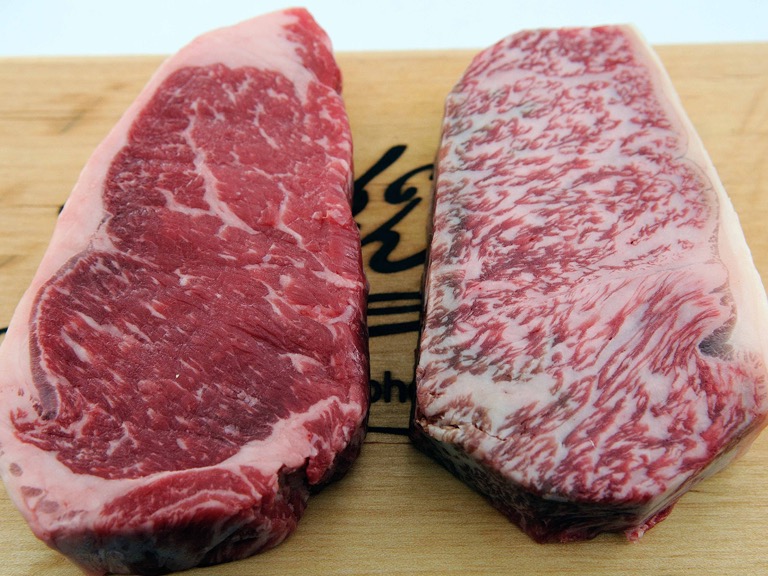
Wagyu vs Amegyu
Wagyu vs Amegyu
Wagyu vs Amegyu
The way one thinks about beef is fundamentally different between America and Japan.
It seems that the general philosophy of the Americans is; more is better.

As this is borne out by the massive steaks, hamburgers, and ribs available in the dinning establishments of the US. As well as the plethora of meat products to choose from at the supermarket, it seems like meat is consumed for almost every meal in America household.
What about Japanese beef, know as “Wagyu”?
As you may or may not know, Japanese beef is highly valued throughout the world for its high quality.
In particular you can look to renowned beef producing regions of Japan including; Matsuzakagyu, Kobegyu, or the incredible YonezaWagyu.
Have you ever had the opportunity to try “Wagya”?
The secret behind the incredible flavour of Wagyu is in the raising of these cattle.
These animals live in luxurious condition and are pampered for 18 months more than regular American beef; 3 full years.
Indeed, in light of these facts, the cost of such beef is at a premium.
Additionally, the meticulous marbling is the signature of Wagyu, and not only does this marbling provides an exquisite texture that melts in your mouth, but compared to other types of beef, Wagyu is rich in monounsaturated fatty acid (oleic acid).
And due to the very high ratio of this oleic acid, Wagyu has a rich and powerful flavour; a must try for all beef connoisseur
When I first came to Japan, beef was extraordinarily expensive and was thought of as an item for special occasions only.
I once went into a butcher shop and was shocked by the price of their beef, with the most expensive one coming in at ¥1,000/100g (USD $9.50/3.5oz).
It was extremely delicious to say the least, but not something on the daily shopping list.
During this time there was some trade friction between the US and Japan concerning the non-tariff trade barriers to American beef and oranges.
And just when this friction between partners seemed to have been resolved, mad cow disease shows up.
In 1986, the first case of mad cow disease was discovered in the UK. A few year later, Japan’s first mad cow disease was discovered in 2001, and Japan banned beef imports from 2003 to 2013 when the regulations were finally relaxed.
As such, we are seeing a significant increase in the amount of beef being consumed by the Japanese, much of it imported.
Could it be that the only successful American warehouse club in Japan has gained traction and is the reason why ”all-you-can-eat” yakiniku (Korean BBQ style) restaurants popping up all over Japan.
Examining this trend you could say that the Japanese as a culture have always taken from outside influences, and make them incrementally better over time (kaizen).
Where will the Japanese take the American way of eating beef, and what will be the consequences on the health of the Japanese citizens in the future?
Only time will tell.



Recent Comments